Text by Izumi Hoshi • Published in Tibetan Literature and Filmmaking Today: SERNYA, Vol. 6, pp. 199–203 (2019)

ARTIST PROFILE
BIN BAI (GENTSU GYATSO)
Born in 1978 in Kandze, Eastern Tibet (Garzê Tibetan Autonomous Prefecture, Sichuan Province, China). His Tibetan name is Konchok Gyatso (Gentsu Gyatso). He studied traditional Chinese painting at the undergraduate and graduate schools of the Sichuan Fine Arts Institute in Chongqing, and also studied abroad at the Kunsthochschule Kassel in Germany. From 2004 to 2014, he served as a lecturer in fine arts at Southwest Minzu University in Chengdu. Currently based in Adelaide, Australia, he is involved in various projects across animation production, painting, and fashion design to harness the latent power of traditional aesthetics in modern society. His works are available on his website (http://baibinart.com), so please be sure to take a look.
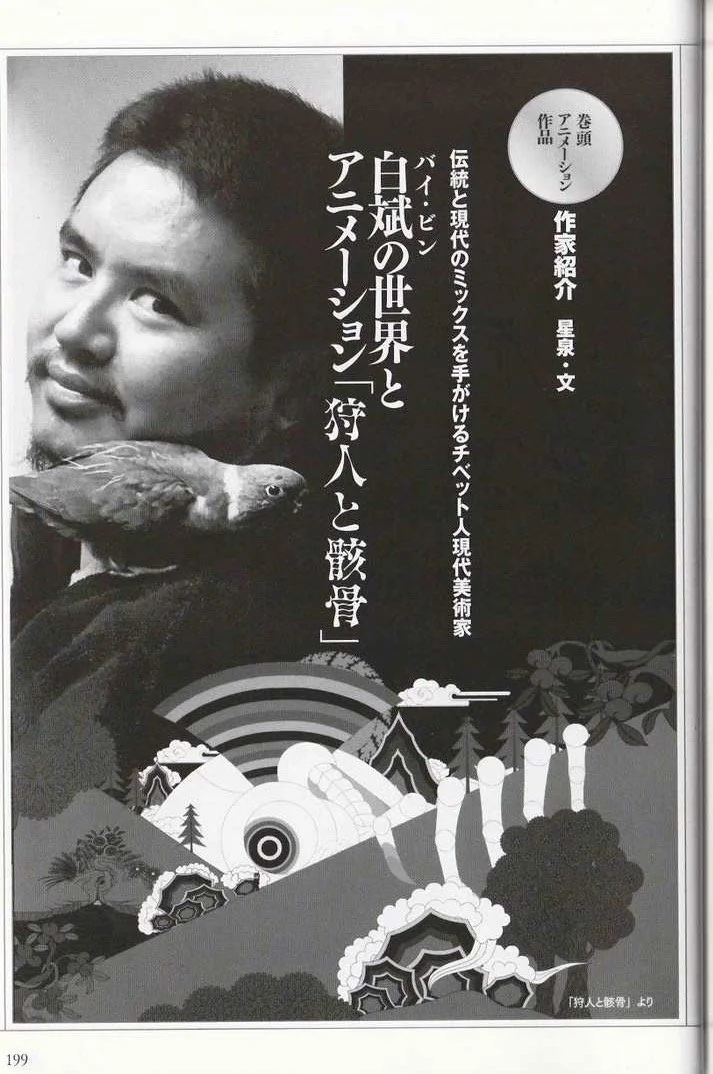
My Encounter with Bin Bai’s Work
While I was creating the translation draft for “The Yak Herder and the Skeleton” (published on pages 77–81 of this issue) for this special feature, an animation I had once seen introduced on a Tibetan news site suddenly came to mind. I couldn't remember the title of the animation, nor could I recall how long ago I had seen it, but because the visuals were so striking, I remembered clicking the link. When I searched the site, I found an article about a Tibetan animation titled The Hunter and the Skeleton. Moreover, the content turned out to be almost identical to the manuscript sitting right in front of me. When I searched further for information using the title, I discovered a still image of a skeleton chasing a man in Tibetan dress—just as it appeared in the story! I was thrilled to learn that The Hunter and the Skeleton was an adaptation of a folktale almost identical to “The Yak Herder and the Skeleton.” Furthermore, I found out that this film had been officially selected for the 2013 International Film Festival Rotterdam, and to top it all off, the entire work was publicly available on the film festival's official YouTube account.
I watched the work immediately and could not contain my excitement. It was an audiovisual work unlike anything I had ever seen before. While utilizing painting techniques used in traditional Tibetan Buddhist art, the animation itself is dynamic, with the characters moving mysteriously across a flat plane with vivid colors and simple, bold lines. Watching it gives you the illusion of having wandered into a computer game world.
In the battle scenes where the skeleton transforms into a giant, the comical movements are hilarious, and yet, the giant, transforming skeleton also gives a strange sense of déjà vu. Thinking about why, I realized it resembled the giant skeleton monster in Utagawa Kuniyoshi’s ukiyo-e print Takiyasha the Witch and the Skeleton Spectre. When I later asked Bin Bai about this, he said he had a great affinity for Japanese ukiyo-e prints, and indeed, there was a clear commonality there. Influenced not only by Tibetan traditional painting but also deeply by East Asian art, he seems to be creating works that appeal to both aesthetic sensibilities.
The music also draws attention. Traditional Tibetan instruments like the dranyen (lute), piwang (fiddle), and gyaling (shawm) are used alongside traditional folk singing styles, while modern piano and synthesizer tones are heavily incorporated, creating a unique groove with a sharp beat throughout. In the scenes where the beat shifts into a rock style and the fast-paced piwang melody plays continuously, the music and visuals mesh brilliantly to showcase a sense of speed and tension. This bold, stimulating mix further highlights the characters caught between tradition and modernity.
And what is most intriguing is that the story of this animation is virtually the same as the folktale “The Yak Herder and the Skeleton” featured in this issue. Somehow, I wanted to get in touch with him. However, I couldn't find any shared acquaintances, and I couldn't reach him right away. Around that time, I noticed that the artist himself had a YouTube channel, so I sent a message through it. About two months passed while I waited, and I had nearly given up when I received a message from the artist himself via chat. He welcomed the message from a Japanese fan and readily agreed to cooperate. Thus began a collaboration that would have a major impact on the editorial design of this issue.
The Hunter and the Skeleton
THE HUNTER AND THE SKELETON • 2012 / China / Short Animation / Color / 26 min / Kham Tibetan Dialect / English Subtitles
Director, Design, Editing: Bin Bai Script: Gendun Choephel (Rinpoche)
Animation Production: Gawang Dolma (Rinpoche), Sangye Tashi, Yutso, Nyima, Dawa, Tenzin Rinchen
Music: Waf Gyatso (Rinpoche), Bin Bai
Voices / Narration: Bin Bai, Dawa Gyatso, Lama: Sonam Phuntsok, Old Man: Kunga
(Rinpoche)
Design, Storyboard, Direction: Bin Bai Editing: Bin Bai, Katsura Matsukawa
FILM FESTIVAL SELECTIONS (PARTIAL LIST)
• 2012: 9th Beijing Independent Film Festival, 9th China Independent Film Festival (Nanjing), Vancouver International Film Festival
• 2013: International Film Festival Rotterdam • 2014: Zurich Film Festival
• 2015: Ottawa Tibet Film Festival
On the Origin of the Name “Bin Bai”
By the way, when I asked Bin Bai about his name—thinking it was unusual for a Tibetan— he explained that his Tibetan name is Konchok Gyatso (dkon mchog rgya mtsho), and when he reached school age, his parents gave him the Chinese name “Bai Bin” so he wouldn't stand out as an ethnic minority at school. “Bai” is a surname, though Tibetans originally do not have surnames. Strangely enough, “Bin” is also a surname. When I asked about this strange coincidence, he shared a heartwarming story: his father, a graduate of the Sichuan Fine Arts Institute, had originally named him Gyatso Tsering (meaning “Ocean of Long Life”). When the 10-year-old boy entered the Sichuan Fine Arts Institute, a teacher who knew his Tibetan name meant “Baiyang” (Hundred Years) gave him the Chinese name “Bai Bin,” which sounded similar in the Sichuan dialect. In other words, the character “Bai” reflects the family history of producing artists across two generations.
Collaborative Art of Language and Visuals
Now, the color gravure pages of this issue of SERNYA feature a collaboration between two animations: An Apple Tree by the famous Tibetan singer-songwriter Jampel Gyatso (also known as Jampel) and The Hunter and the Skeleton by Bin Bai. The energy of poetry born from the world of language rooted in the Tibetan earth, combined with the gods and spirits leaping out from the modern world by borrowing the power of art, merges through the medium of skeleton monsters and captivates us. Looking at Monster Search, which
Jampel specially wrote for this issue, I hadn't realized it when I first read the manuscript for the second issue, but lining them up like this creates no sense of incongruity at all. In fact, it makes me feel that he might be an artist born from a world that is constantly in contact with the “otherworld.”
Furthermore, for the specially commissioned essay “Ghosts” by writer Lhashamgyal (pages 18–25 of this issue), we featured a collaboration with Bin Bai’s fashion designs (special costume designs). His attractive designs, which use motifs like the rare patterns found on Tibetan dzi beads (sky beads), fit seamlessly into the world of Lhashamgyal’s enchanting essays. Moreover, this astonishing collaboration was proposed for the first time by our magazine's designer, Kazue Aoki, with the idea of “involving this magazine in a battle of otherworlds.”
The Hunter and the Skeleton and “The Yak Herder and the Skeleton”
According to Bin Bai, the folktale “The Hunter and the Skeleton” is a story passed down in Eastern Tibet. On the other hand, “The Yak Herder and the Skeleton,” translated and included in this issue, is thought to have been passed down on the Changtang Plateau in Central Tibet, meaning this folktale was likely told across a wide region beyond just Eastern Tibet.
I leave the comparison of the differences between the stories to your reading of the translation in this issue alongside Bin Bai's animation, though there are a few notable points to mention. In “The Yak Herder and the Skeleton,” the “breath bag” (a leather pouch that stores life energy) plays an important role, whereas in The Hunter and the Skeleton, it does not appear; instead, the skeleton is depicted as an item that recharges life energy from the skull. The ending, where the skeleton's item is smashed to pieces to defeat it, is common to both. While there are several other shared elements, what is interesting is the setup where the skeleton fears a place with no footprints (in “The Yak Herder...” it is a mountain without footprints). In determining the skeleton's character design, Bin Bai mentioned that he researched and verified folktales from various regions. From a more macro perspective, it is also deeply interesting that while “The Yak Herder...” has almost no religious elements and carries the flavor of a folktale likeMomotaro or Urashima Taro, The Hunter... brings the power of religious faith to the forefront.
Similar stories probably exist across the steppes (and perhaps in other parts of the world as well). I secretly hope that if this animation triggers the discovery of more variants of this story, it will lead to fascinating developments. Of course, I also hope to see more of his new works as well.
SERNYA Vol. 6 (2019), pp. 199–203 — English Translation |
Translated from the original Japanese article by Izumi Hoshi in Tibetan Literature and Filmmaking Today: SERNYA, Vol. 6 (2019), pp. 199–203.